Whether you’re a first-time homebuyer or a third-time home seller, the real estate transaction can be confusing and stressful enough—even without the many terms and acronyms used during the process.
But don’t be overwhelmed. Here’s a mini-glossary of important terms to help you better understand what’s going on with a home sale.
As Steve Jobs once said: “There’s always one more thing to learn.”
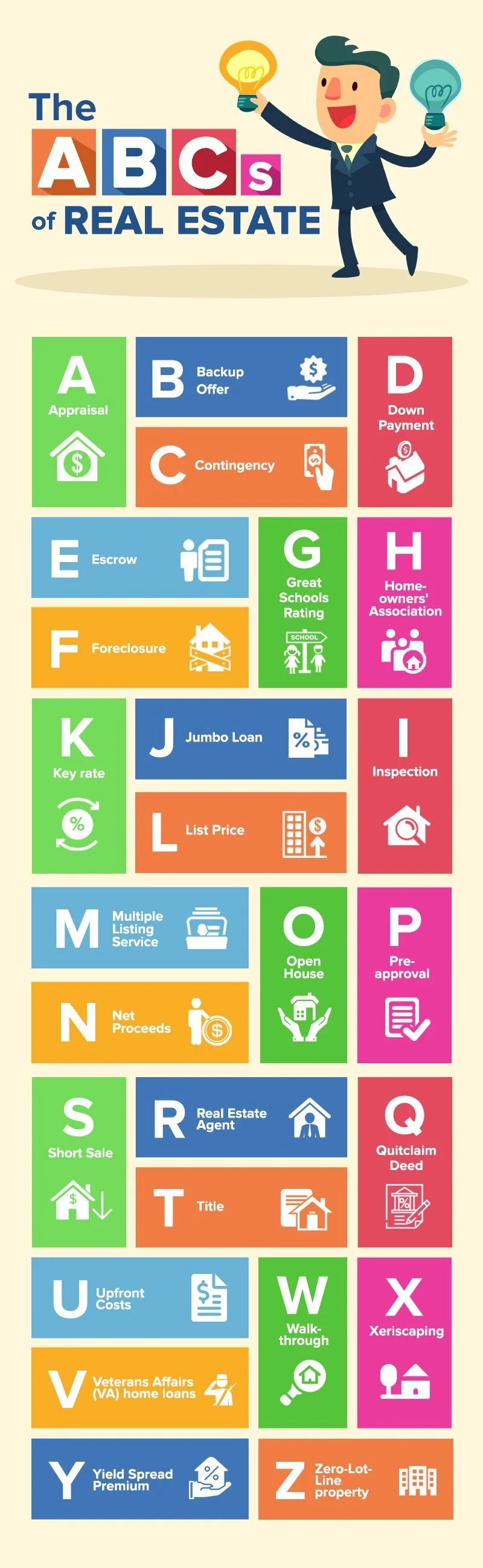
A — Appraisal
A professional estimate of a property’s value by a certified appraiser, often required by lenders before issuing a mortgage. Appraisers assess similar recent sales (“comps”), home condition, size, location, and quality to determine value. Be aware of appraisal myths.
B — Backup Offer
A secondary offer on a home already under contract. It becomes active if the primary sale falls through.
C — Contingency
A condition that must be met for a real estate transaction to proceed. Common contingencies include financing, inspection, sale, title, and appraisal.
D — Down Payment
The upfront cash paid to the seller, typically 0–20% of the purchase price depending on the loan type. Programs like FHA (3.5% down), VA, and USDA (no down payment) can help.
Bonus: Debt-to-Income Ratio (DTI) compares debt payments to income. A lower DTI improves your mortgage eligibility.
E — Escrow
A neutral third party handling money and documents until all sale terms are met.
Bonus: Earnest Money Deposit is a good-faith deposit applied toward closing costs if the sale goes through.
F — Foreclosure
The process by which a lender takes ownership after a borrower defaults.
Bonus: FSBO (For-Sale-By-Owner) means selling without an agent, though most sellers still use one.
G — GreatSchools Rating
A score to help parents evaluate schools, a major factor for many buyers.
H — Homeowners’ Association (HOA)
An organization managing shared housing complexes, collecting fees for maintenance, and enforcing property rules.
I — Inspection
A licensed inspector’s detailed review of a property’s condition, identifying needed repairs.
J — Jumbo Loan
A mortgage exceeding the Fannie Mae/Freddie Mac limits, often used for luxury properties.
K — Key Rate
An interest rate influencing bank lending and credit costs.
L — List Price
The seller’s asking price, set using a Comparative Market Analysis (CMA).
M — Multiple Listing Service (MLS)
A database of homes for sale, accessible only to licensed agents and brokers.
N — Net Proceeds
The seller’s profit after deducting commissions and closing costs.
O — Open House
A scheduled time for prospective buyers to tour a property.
P — Pre-Approval
A lender’s evaluation confirming a borrower’s qualification and loan amount before house hunting.
Q — Quitclaim Deed
Transfers ownership without guarantees, often used in divorce settlements or family transfers.
R — Real Estate Agent
A licensed professional assisting with buying, selling, and negotiating real estate transactions.
S — Short Sale
Selling a home for less than the mortgage owed, often to avoid foreclosure.
T — Title
Legal ownership of property, documented after closing with title insurance.
U — Upfront Costs
Expenses due once an offer is accepted, such as earnest money, inspection fees, and appraisal fees.
V — Veterans Affairs (VA) Loans
Special mortgages for eligible military members, veterans, and some spouses, guaranteed by the VA.
W — Walkthrough
The buyer’s final inspection before closing to ensure agreed-upon repairs are complete.
X — Xeriscaping
Water-efficient landscaping using local, drought-tolerant plants. Learn more.
Y — Yield Spread Premium (YSP)
Compensation paid by lenders to brokers for loans with higher interest rates.
Z — Zero-Lot-Line Property
A building positioned directly on the property boundary, often in townhouse developments.